
What Is Arbitrage Betting? The Complete Guide to Risk-Free Sports Betting
What Is Arbitrage Betting?
Arbitrage betting (also called arbing or surebetting) is a strategy where you place bets on all possible outcomes of a sporting event across different sportsbooks, locking in a guaranteed profit regardless of the result.
This is possible because different sportsbooks sometimes disagree on the odds for the same event. When the combined implied probability across books drops below 100%, an arbitrage opportunity exists, and you can exploit the gap for a risk-free return.
Arbitrage isn't a loophole or a gamble. It's a mathematical certainty, and it's the same principle used by traders in financial markets every day.
How Does Arbitrage Betting Work?
Every sportsbook sets their own odds, and those odds reflect an implied probability. When two or more books price the same market differently enough, the total implied probability falls below 100%, creating an arb opportunity.
The Key Formula
The arbitrage percentage tells you whether an opportunity exists and how profitable it is:
Arb% = (1 / Odds A) + (1 / Odds B)
- If Arb% < 1.00 (or < 100%) → arbitrage exists
- The profit margin = 1 - Arb%
A Real Example
Suppose you find an NBA game where:
- DraftKings has Team A moneyline at +150 (decimal 2.50)
- FanDuel has Team B moneyline at -130 (decimal 1.77)
Let's check for arbitrage:
Arb% = (1 / 2.50) + (1 / 1.77)
Arb% = 0.400 + 0.565 = 0.965
That's 96.5%, which is below 100%, so an arb exists with a 3.5% guaranteed profit margin.
Calculating Your Stakes
With a total bankroll of $1,000 for this bet:
- Team A at DraftKings (2.50): Stake $386.84 → Payout $967.10
- Team B at FanDuel (1.77): Stake $613.16 → Payout $1,085.29
- Total staked: $1,000. Guaranteed return: $967-$1,085
The stake formula for each side:
Stake A = Total Bankroll x (1 / Odds A) / Arb%
Stake B = Total Bankroll x (1 / Odds B) / Arb%
No matter who wins, you profit between $35 and $85 on a $1,000 investment. That's a guaranteed return with zero risk.
Why Do Arbitrage Opportunities Exist?
Sportsbooks operate independently and use different models, data sources, and risk strategies. Several factors create pricing gaps:
1. Different Opinions on Probability
Sharp books like Pinnacle use models driven by professional betting action. Recreational books like DraftKings or BetMGM may shade lines based on public money. These different approaches create disagreements in pricing.
2. Slow Line Movement
When odds shift at one book (due to injury news, sharp action, or model updates), other books may lag behind. That window, often just seconds or minutes, creates arb opportunities.
3. Market Breadth
With 400+ sportsbooks globally offering odds on thousands of markets (moneylines, spreads, totals, props, live bets), pricing gaps are inevitable. The more markets and books you scan, the more arbs you'll find.
4. Promotional Odds
Boosted odds, profit boosts, and promotional lines frequently create artificial arb opportunities. These are often the most profitable and lowest-risk arbs available.
Types of Arbitrage Bets
Two-Way Arbs
The most common type. Two possible outcomes (e.g., moneyline in tennis, over/under in any sport) across two sportsbooks.
Three-Way Arbs
Events with three outcomes, most commonly soccer (home/draw/away). The formula extends naturally:
Arb% = (1 / Odds Home) + (1 / Odds Draw) + (1 / Odds Away)
Three-way arbs are less common but often have higher margins because there are more pricing combinations.
Cross-Market Arbs
Arbing across related but different markets. For example, a player prop "over 24.5 points" at one book vs. "under 25.5 points" at another creates a middle opportunity, and you might even win both sides.
Live Arbs
In-play odds move rapidly during a game, creating frequent but short-lived arbitrage windows. Live arbs require fast execution and real-time data.
How to Find Arbitrage Opportunities
The Manual Approach (Not Recommended)
You could open multiple sportsbook tabs and compare odds yourself. But with hundreds of books, thousands of events, and odds that change by the second, manual arbing is impractical. By the time you spot an opportunity and calculate stakes, it's likely gone.
Using an Arbitrage Scanner
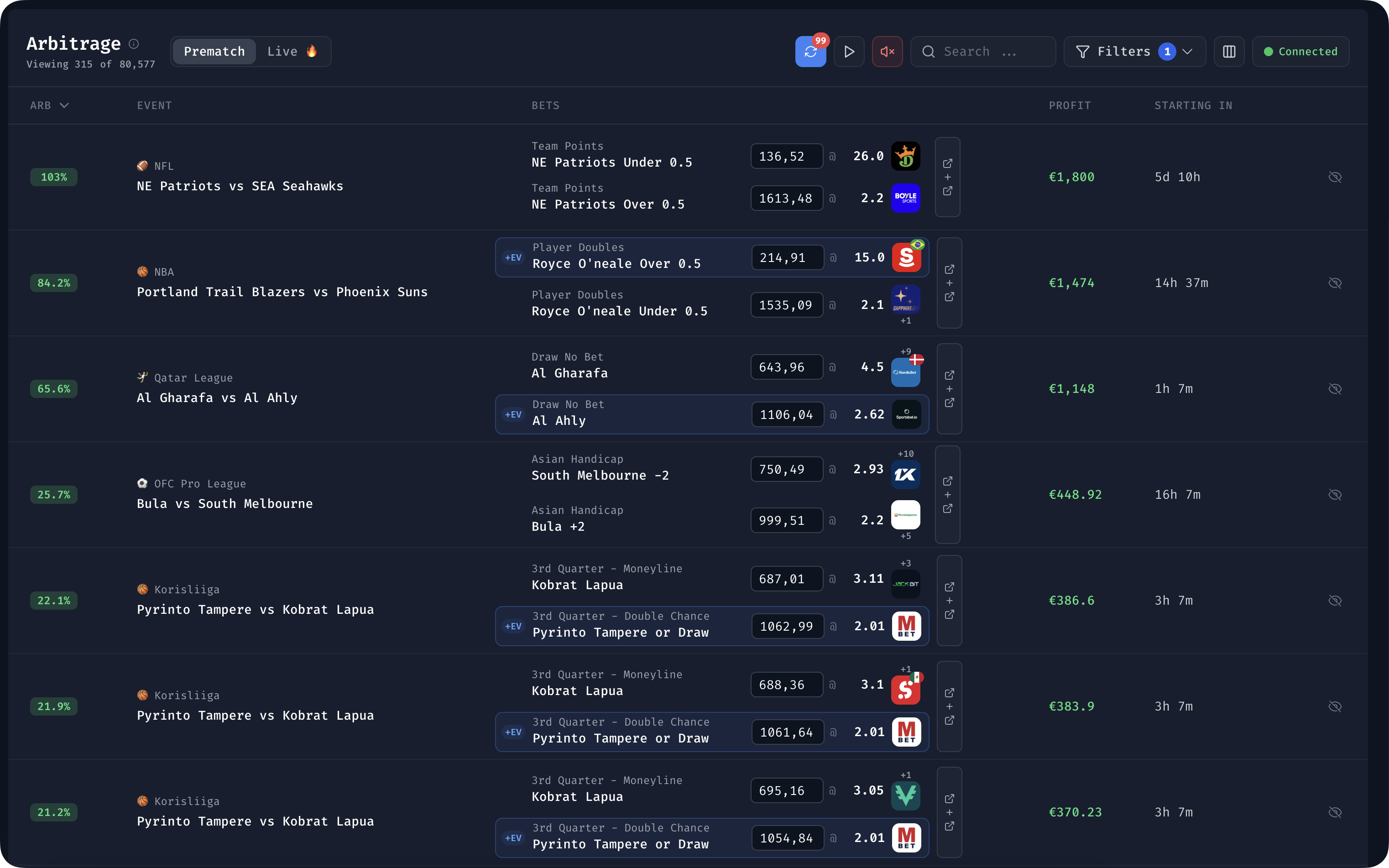
Dedicated tools scan odds across hundreds of sportsbooks in real-time and instantly flag opportunities with:
- The arb percentage (your guaranteed profit margin)
- Exact stake calculations for each side
- Which books have the best odds
- Time sensitivity, showing how long the opportunity is likely to last
The best scanners update in real-time via WebSocket connections, giving you sub-second data so you can act before odds move.
Step-by-Step: Placing an Arbitrage Bet
Step 1: Find the Opportunity
Use an arbitrage scanner to identify a surebet. Look for arbs with a margin of at least 1% because smaller margins have higher risk of odds changing before you place both sides.
Step 2: Verify the Odds
Before placing anything, confirm the odds are still available at both sportsbooks. Odds can move in seconds.
Step 3: Place the Less Liquid Side First
Start with the book that's more likely to move or limit you. This is usually the sharper side or the book with the higher odds. If that side gets taken, you haven't committed any money yet.
Step 4: Immediately Place the Other Side
Place the second bet as quickly as possible. The longer you wait, the higher the risk of odds shifting.
Step 5: Record and Track
Log both bets in your tracker. Track your arb profit, per-book performance, and any limitations over time.
Common Mistakes in Arbitrage Betting
Ignoring Terms and Conditions
Some books void bets on "palpable errors" (obvious mispricing). If one side gets voided and the other doesn't, you're left with a naked bet. Avoid arbs that rely on obviously wrong lines.
Not Accounting for Fees
Some books charge fees on deposits, withdrawals, or use different odds formats that affect your actual payout. Factor these into your arb calculation.
Rounding Errors
Small rounding in stake calculations can turn a thin arb into a loss. Always use precise calculations, not mental math.
Betting Both Sides at the Same Book
Most sportsbooks flag and void opposing bets on the same event from the same account. Always use different books for each side.
Moving Too Slowly
Arb windows can close in seconds. If you can't place both sides quickly, consider skipping thin-margin opportunities (under 1%).
Will Sportsbooks Limit You?
Yes, eventually. Sportsbooks don't like consistent winners, and arbers are easy to detect (always taking the best line, unusual stake amounts, no loyalty to a single book).
Common signs of being limited:
- Max bet reduced. Your allowed stake drops dramatically
- Odds change on you. The odds shift when you add to your bet slip
- Account restricted. You're locked out of certain markets
How to Minimize Limits
- Spread action across many books and don't hammer the same book repeatedly
- Round your stakes. $487.32 looks algorithmic; $490 looks human
- Bet recreational markets too and mix in some normal bets
- Don't always take the max. Vary your stake sizes
- Use multiple books since the more books in your rotation, the longer each lasts
Arbitrage vs. Value Betting: What's the Difference?
| Arbitrage | Value Betting | |
|---|---|---|
| Risk | Zero (guaranteed profit) | Variance (profitable long-term) |
| Profit per bet | Small (1-5%) | Larger (2-15%+ EV) |
| Volume needed | High | Moderate |
| Skill | Execution speed | Probability assessment |
| Sustainability | Limited by account restrictions | More sustainable long-term |
Many serious bettors use both strategies: arbing for guaranteed income and value betting for higher long-term returns.
How Profitable Is Arbitrage Betting?
Realistic expectations:
- Average arb margin: 1-3% per bet
- Bets per day: 5-20 (depending on available markets and books)
- Monthly ROI on bankroll: 5-15% (varies with volume and available arbs)
The main constraints are:
- Bankroll tied up. Your money is locked between placing and settling
- Account limits. Books will eventually restrict you
- Speed required. You need to act fast and have funds ready across multiple books
Getting Started with Arbitrage Betting
Arbitrage betting is one of the few genuinely risk-free strategies in sports betting. It requires discipline, speed, and the right tools, but the math is on your side every single time.
The key principles:
- Always verify both sides before placing any bet
- Place the less liquid side first to minimize risk
- Use precise stake calculations because rounding kills thin margins
- Track everything: your bets, profits, and per-book status
- Diversify across many sportsbooks to extend your runway
- Use real-time tools since manual arbing is impractical in 2025
Put this into practice
Bet Hero scans 400+ sportsbooks in real-time to find +EV bets and arbitrage opportunities so you don't have to.
Keep reading
Futures Betting Strategy: When to Bet and When to Hedge
Master futures betting with smart timing and hedging strategies. Learn when to bet season-long markets, how to manage positions, and when cashing out makes sense.
Prop Betting Strategy: Finding Edge on Player Props
Master player prop betting with proven strategies. Learn how to identify mispriced props, build projection models, and find consistent edge in the fastest-growing betting market.