
What Are Value Bets? A Complete Guide to Positive Expected Value Betting
What Is a Value Bet?
A value bet occurs when the odds offered by a sportsbook imply a lower probability than the true likelihood of an outcome. In other words, the bookmaker has mispriced the market in your favor.
Think of it like finding an item on sale below its actual worth, except instead of shopping, you're identifying edges in the betting market.
Understanding Expected Value (EV)
Expected value is the mathematical foundation of value betting. It represents the average amount you'd win (or lose) per bet if you placed the same wager thousands of times.
The formula is straightforward:
EV = (Probability of Winning x Profit) - (Probability of Losing x Stake)
When EV is positive (+EV), the bet has value. When it's negative (-EV), the sportsbook has the edge.
A Quick Example
Say you find a bet at +150 (decimal 2.50) odds, and you calculate the true probability of winning is 45%.
- Implied probability from odds: 40% (1 / 2.50)
- True probability: 45%
- EV per $100 bet: (0.45 x $150) - (0.55 x $100) = +$12.50
That's a 12.5% edge and a strong value bet.
Why Sportsbooks Misprice Markets
Sportsbooks aren't perfect. Several factors create value opportunities:
- Public bias. Heavy action on popular teams forces books to shade lines, creating value on the other side
- Slow line movement. Some books are slower to adjust odds after sharp market moves
- Market complexity. Player props and alternative lines across 400+ sportsbooks create pricing gaps
- Promotional lines. Boosted odds and specials can sometimes offer genuine +EV
How to Find Value Bets
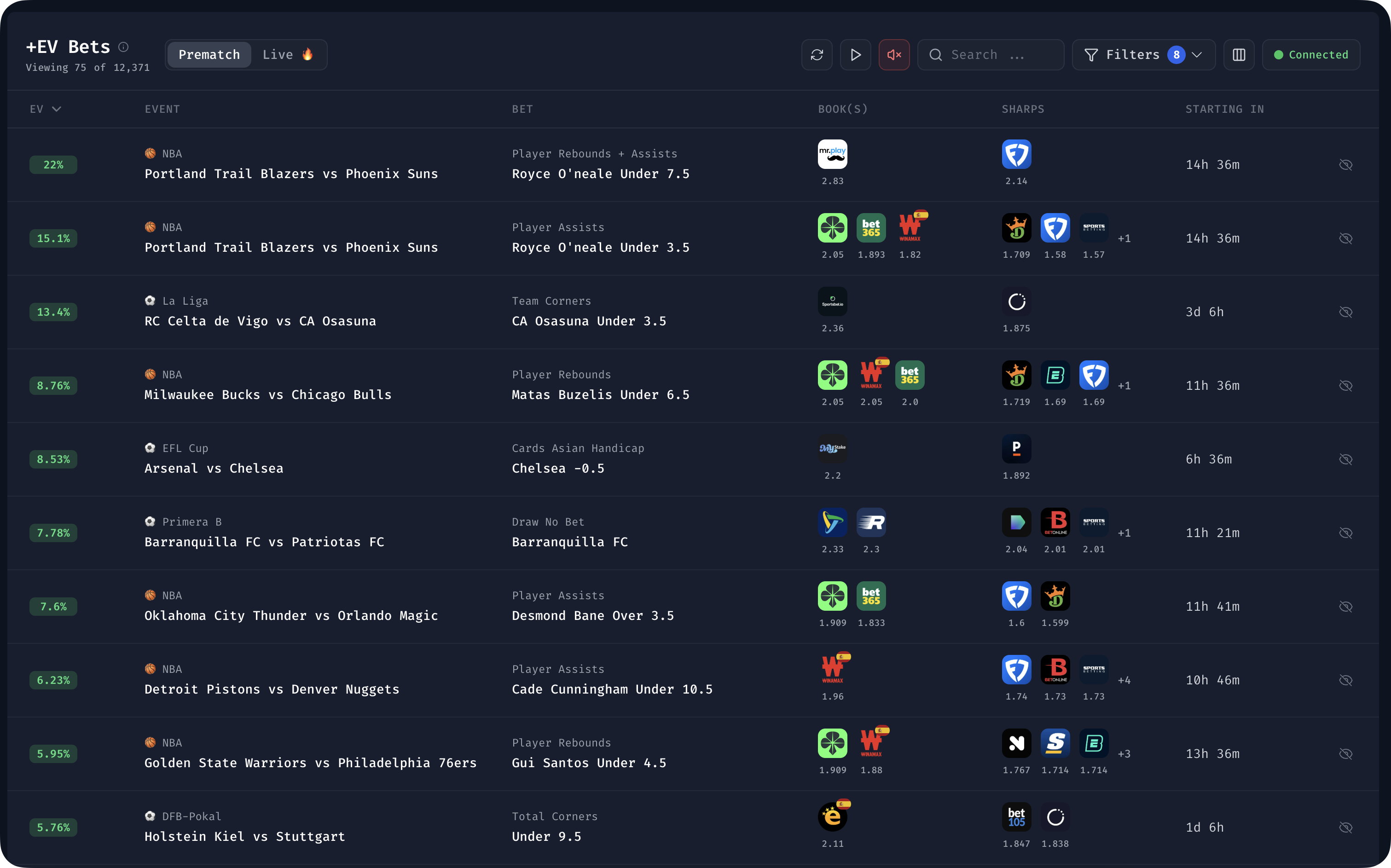
Finding value bets manually is nearly impossible across hundreds of sportsbooks and thousands of markets. Here's what you need:
1. Sharp Reference Lines
You need a source of "true" odds to compare against. Professional bettors and tools use sharp sportsbooks (like Pinnacle) as a baseline because their lines are the most efficient.
2. No-Vig Calculation
Remove the bookmaker's margin (vig) from the sharp line to get the true fair probability. This is done using devigging formulas such as multiplicative, additive, power, or Shin method.
3. Comparison Engine
Compare the devigged fair odds against every available sportsbook to find prices that exceed fair value.
4. Speed
Markets move fast. A value bet at 2:00 PM might be gone by 2:01 PM. You need real-time data and alerts to act before odds adjust.
The Kelly Criterion: Sizing Your Bets
Finding +EV bets is only half the equation. Bet sizing determines whether you survive the variance long enough to realize your edge.
The Kelly Criterion calculates the optimal stake based on your edge and the odds:
Kelly % = (bp - q) / b
Where:
- b = decimal odds - 1
- p = true probability of winning
- q = 1 - p (probability of losing)
Most professional bettors use fractional Kelly (half or quarter) to reduce volatility while still growing their bankroll.
Common Mistakes in Value Betting
Chasing High EV Only
A 20% EV bet sounds great, but if the probability is only 5%, you'll face brutal losing streaks. Balance EV percentage with probability and bankroll management.
Ignoring Closing Line Value (CLV)
CLV measures whether you beat the closing odds. Consistently beating the close is the strongest indicator of a skilled bettor, even more reliable than short-term results.
Betting at Limited Books
If you're consistently winning at a sportsbook, they may limit your account. Diversify across multiple books and manage your accounts wisely.
Getting Started with Value Betting
Value betting isn't gambling. It's a systematic, mathematical approach to sports betting. With the right tools and discipline, you can build a sustainable edge.
The key principles:
- Only bet when you have positive expected value
- Size your bets using Kelly criterion
- Track everything: your bets, CLV, and per-book performance
- Stay disciplined through losing streaks (they're inevitable with any edge)
- Use real-time tools to find and act on opportunities before they disappear
Put this into practice
Bet Hero scans 400+ sportsbooks in real-time to find +EV bets and arbitrage opportunities so you don't have to.
Keep reading
Futures Betting Strategy: When to Bet and When to Hedge
Master futures betting with smart timing and hedging strategies. Learn when to bet season-long markets, how to manage positions, and when cashing out makes sense.
Prop Betting Strategy: Finding Edge on Player Props
Master player prop betting with proven strategies. Learn how to identify mispriced props, build projection models, and find consistent edge in the fastest-growing betting market.