
Prop Betting Strategy: Finding Edge on Player Props
Why Props Are the New Frontier
Player props have exploded in popularity and represent the fastest-growing segment of sports betting. More importantly for sharp bettors, they're among the most inefficient markets available.
Here's why props offer edge:
- Massive inventory: Hundreds of props per game means less sharp attention per market
- Model limitations: Sportsbook prop models are less sophisticated than spread/total models
- Correlation complexity: Props interact in ways that are hard to price perfectly
- Retail book focus: Props are designed for recreational bettors, creating soft lines
Understanding Prop Market Structure
Who sets prop lines:
Most sportsbooks don't originate prop lines themselves. They use:
- Third-party odds providers
- Adjusted feeds from other books
- Simple formulas based on season averages
This creates uniformity but also creates opportunities when the consensus is wrong.
Higher vig, more error:
Props typically carry 10-20%+ vig (compared to 4.5% on sides). The higher margin exists because:
- More variance in outcomes
- Less sharp betting pressure
- More entertainment value to casual bettors
Higher vig means you need more edge to profit, but it also signals that books are less confident in their numbers.
Finding Edge: The Core Approaches
1. Build Your Own Projections
The most reliable prop edge comes from having better projections than the market.
For a player's rushing yards, consider:
- Season average
- Opponent rush defense (DVOA, EPA allowed)
- Game script (projected game flow)
- Offensive line performance
- Recent workload trends
- Weather (for outdoor games)
- Injuries to other skill players (more/less opportunity)
Compare your projection to the prop line. If your projection is 75 yards and the over is set at 64.5, that's potential value.
2. Spot Correlation Opportunities
Props within the same game are correlated but often priced independently.
Example correlations:
- If Team A's QB throws for 350 yards, their WRs probably have big games
- If a game goes to overtime, totals on individual stats increase
- If one RB is ruled out, the backup's props should spike
Sportsbooks adjust for obvious correlations but miss subtle ones. Finding mispriced correlations is an edge.
3. News and Lineup Edge
Prop lines are often set before full information is available:
- Injury updates (target's corner is out)
- Lineup changes (backup RB gets start)
- Weather changes (wind kills passing props)
- Game-time decisions (snap count, pitch count)
Being faster than the market to process news creates edge.
4. Same-Game Parlay Arbitrage
Same-game parlays often misprrice correlations. Some SGP combinations offer +EV even with the parlay tax because the correlation isn't fully removed.
Our +EV tool scans individual props, but checking SGP pricing manually can reveal hidden value.
Sport-Specific Prop Strategies
NFL Props
Most liquid prop market with the most attention.
Best NFL prop edges:
- Receiving props (high variance, hard to model)
- Rushing props (more predictable, look for game script edges)
- Passing yards against specific defenses
- Defensive/ST touchdowns (underpriced variance)
Key factors:
- Game script is everything (trailing teams throw more)
- Red zone usage rates
- Target share and air yards
- Opponent rankings by position
NBA Props
Highest volume of props, fastest-moving lines.
Best NBA prop edges:
- Points + rebounds + assists (PRA) totals
- Pace-adjusted projections
- Rest day/back-to-back impacts
- Matchup-specific (who guards who)
Key factors:
- Minutes projection (the foundation)
- Pace (fast teams = more possessions = more stats)
- Home/road splits
- Opponent defensive rating
MLB Props
Pitcher and hitter props with high variance.
Best MLB prop edges:
- Strikeout props (most predictable)
- Hits + runs + RBI totals
- Pitcher outs recorded
- First 5 innings (F5) pitcher lines
Key factors:
- Batter vs. pitcher matchup history
- Pitcher strikeout rates vs. batter whiff rates
- Ballpark factors
- Weather (especially wind for HR props)
NHL Props
Smaller market, potentially more inefficiency.
Best NHL prop edges:
- Shots on goal (most predictable)
- Points props for star players
- Goalie save props
- Power play-related stats
Key factors:
- Ice time projection
- Line combinations
- Power play deployment
- Opponent shot volume allowed
Building a Simple Prop Model
You don't need machine learning. A basic model can find edge:
Step 1: Establish baseline Player's season average for the stat (per game or per opportunity)
Step 2: Adjust for opponent Is the opponent above or below average at defending this stat?
Step 3: Adjust for game environment
- Projected game total (over/under)
- Spread (winning/losing team tendencies)
- Pace (for basketball)
Step 4: Adjust for recent form Weight recent games more heavily if there's a reason (injury return, role change)
Step 5: Compare to market If your projection differs significantly from the line, investigate why. If you can't find a reason, you may have edge.
Example:
- Patrick Mahomes season average: 285 pass yards
- Opponent allows 260 yards to QBs (8% below average)
- Game total is high (51), suggesting shootout potential (+5%)
- Recent form: 310, 295, 305 (+3% adjustment)
Adjusted projection: 285 * 0.92 * 1.05 * 1.03 = 283 yards
If the line is 274.5, that's potentially playable.
Prop Betting Mistakes to Avoid
1. Ignoring the vig Props have high vig. A small edge isn't enough. You need meaningful separation between your projection and the line.
2. Overvaluing recent performance One great game doesn't change a player's true talent. Don't chase outliers.
3. Ignoring game script A 20-point favorite's RB might not need 25 carries. A trailing team's WRs get more targets.
4. Betting too many correlated props If you bet 5 Chiefs receiving overs, you're making one bet on Mahomes. Diversify.
5. Chasing steam on props By the time prop lines move, the value is often gone. Be a price maker, not a price taker.
Tracking and Improving
Track your prop bets separately:
- Record your projection vs. the line
- Track closing line value (did the line move your way?)
- Compare to actual results
- Identify which prop types you have edge on
Iterate:
- If you consistently miss on rushing props, adjust your model
- If you beat closing line on passing props, you have edge
- Focus on what works, abandon what doesn't
Using Tools to Find Prop Value
Prop markets move fast and inventory is huge. Manual scanning is inefficient.
Our value bet scanner identifies +EV prop opportunities by:
- Comparing prop prices across books
- Calculating fair value using sharp consensus
- Highlighting significant deviations
- Filtering by sport, stat type, and edge size
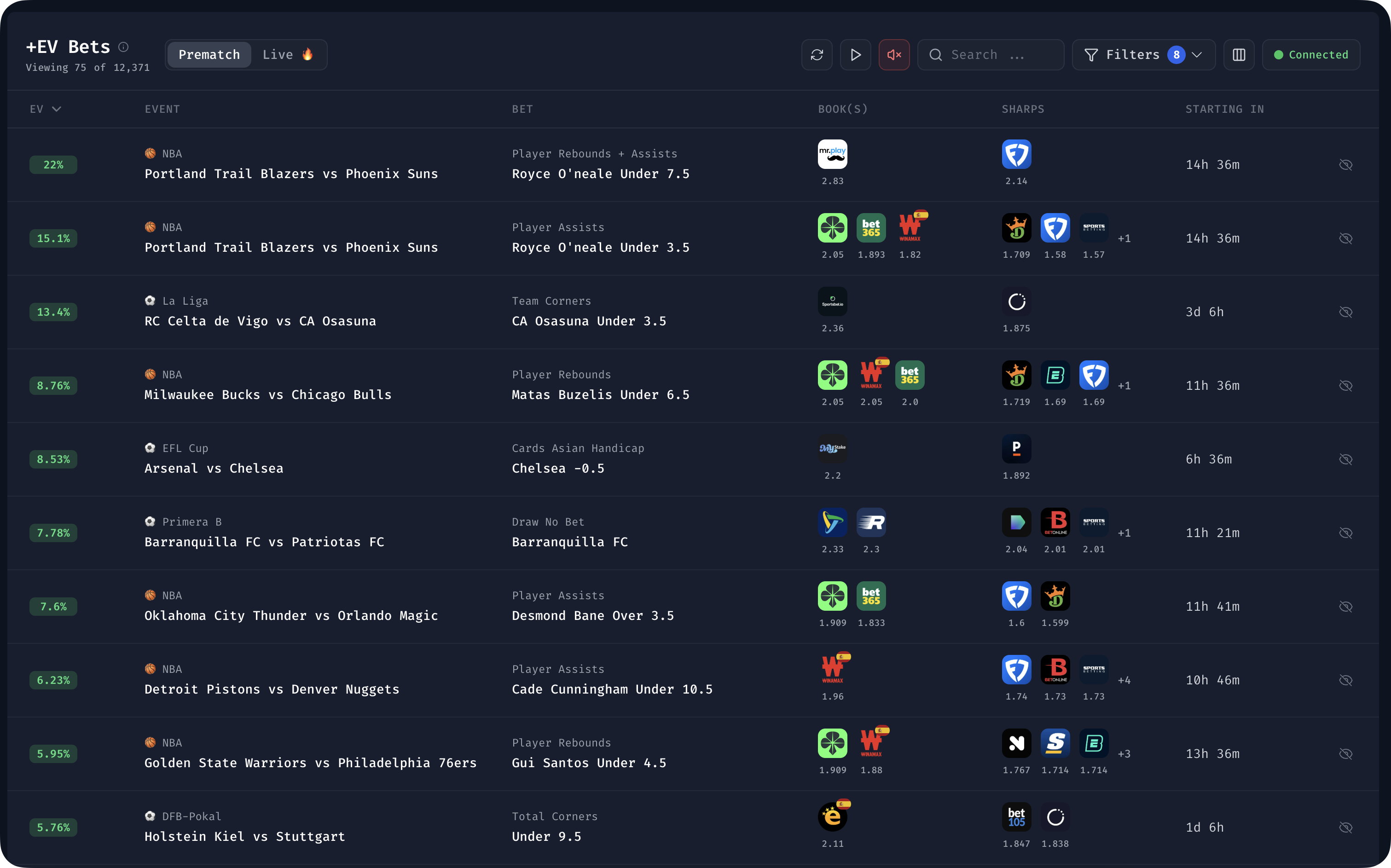
This automates the tedious comparison work, letting you focus on validating opportunities.
Key Takeaways
- Props are the most inefficient betting market due to size and complexity
- Build your own projections rather than blindly betting
- Consider game script, matchups, and pace for every prop
- Correlation between props creates edge when mispriced
- Higher vig means you need meaningful edge (5%+) to profit
- Track your props separately and identify where you have edge
- Use news and lineup info faster than the market
- Avoid chasing recent performance and ignoring game context
- Tools like the Bet Hero +EV scanner help identify mispriced props efficiently
Put this into practice
Bet Hero scans 400+ sportsbooks in real-time to find +EV bets and arbitrage opportunities so you don't have to.
Keep reading
Futures Betting Strategy: When to Bet and When to Hedge
Master futures betting with smart timing and hedging strategies. Learn when to bet season-long markets, how to manage positions, and when cashing out makes sense.
Weather Impact on Betting: NFL, MLB, Golf Analysis
How weather affects betting lines and outcomes in outdoor sports. Learn to factor wind, rain, temperature, and humidity into your handicapping.