
Variance in Sports Betting: Why Losing Streaks Don't Mean You're Wrong
The Reality of Betting Variance
Every bettor faces this moment: you've done everything right, found +EV bets, managed your bankroll, and you're still down after 200 bets.
Is something wrong with your strategy? Probably not. You're experiencing variance.
Variance is the gap between expected results and actual results over any given sample. Understanding it is the difference between a sustainable betting career and quitting after a bad month.
What Variance Actually Means
Imagine flipping a fair coin 100 times. You'd expect 50 heads. But getting exactly 50 is unlikely. Getting 45 or 55 is normal. Getting 40 or 60 is uncommon but happens.
Betting works the same way:
- Your "expected" results are based on your edge
- Actual results swing above and below that expectation
- Small samples have wild swings; large samples converge to expectation
A +3% edge bettor betting 100 games:
- Expected profit: +3 units
- Realistic range: -15 to +21 units
- That's not a typo. Even with an edge, losing 15 units over 100 bets is within normal variance.
Calculating Expected Variance
The math behind variance uses standard deviation.
For betting at -110 odds (standard vig):
Standard Deviation per bet ≈ 1 unit
Standard Deviation over N bets ≈ √N units
What this means:
- 100 bets: SD ≈ 10 units
- 400 bets: SD ≈ 20 units
- 1,000 bets: SD ≈ 31.6 units
Your results will fall within 2 standard deviations of expectation about 95% of the time.
Example:
- 500 bets with 2% edge
- Expected profit: +10 units
- SD over 500 bets: √500 ≈ 22.4 units
- 95% range: 10 ± 45 units = -35 to +55 units
Even with a solid edge, ending up -35 units after 500 bets is within normal variance.
Why Variance Feels Worse Than It Is
Psychological biases:
- Loss aversion: Losses feel 2x as painful as equivalent wins feel good
- Recency bias: Your last 10 bets feel more important than your last 1,000
- Pattern-seeking: We see streaks as meaningful when they're random
Mathematical reality:
In any 500-bet stretch, you should expect:
- At least one 10-bet losing streak
- Multiple 5-bet losing streaks
- Periods where you're down 20+ units from your peak
These aren't signs of failure. They're statistical certainties.
Real Examples of Variance
Scenario 1: The Brutal Start
A bettor with 3% edge places 200 bets at -110. Expected profit: +6 units.
Actual result: -22 units (well within 2 standard deviations)
The bettor quits, thinking their strategy doesn't work. But they were on the unlucky side of a normal distribution. If they continued, the edge would have materialized.
Scenario 2: The Lucky Beginner
A bettor with 0% edge (no skill) places 150 bets. Expected profit: 0 units.
Actual result: +18 units (also within normal variance)
The bettor thinks they've cracked the code. They increase stakes. Variance eventually corrects, and they lose everything.
The lesson: Short-term results tell you almost nothing about long-term edge.
How Many Bets to Know Your True Edge?
This is the million-dollar question. The uncomfortable answer: more than most people think.
Rough guidelines:
- 500 bets: Directional signal (positive vs. negative)
- 1,000 bets: Reasonable confidence in edge magnitude
- 2,500+ bets: High confidence in true edge
For a 2% edge bettor:
- After 500 bets, there's a 25% chance they're showing a loss
- After 1,000 bets, that drops to about 15%
- After 2,500 bets, it's under 5%
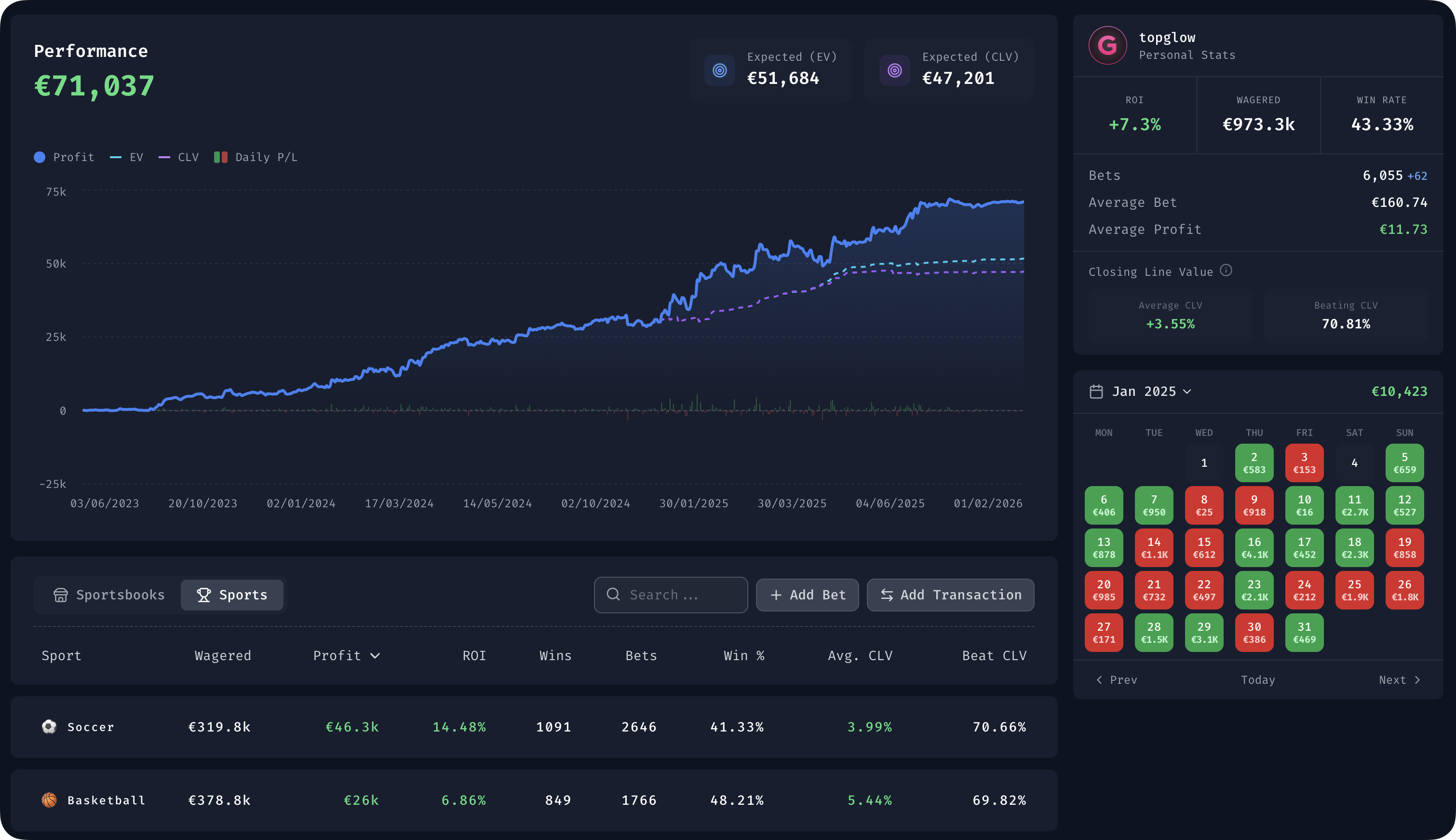
This is why tracking matters. Our bet tracker helps you log every bet and see your results over meaningful sample sizes.
Variance by Bet Type
Not all bets have equal variance:
Lower variance:
- Point spreads at -110
- Totals at -110
- Heavy favorites on moneyline
Higher variance:
- Underdogs at +200 or higher
- Parlays (any size)
- Long-shot futures
- Player props at plus odds
A parlay bettor might need 5x the sample size to confirm edge compared to a spread bettor.
Implication: If you're betting lots of plus-money props, expect wilder swings. That doesn't mean you're doing anything wrong.
Managing Variance Emotionally
1. Pre-commit to sample sizes
Before betting, decide: "I will evaluate my results after 500 bets, not before."
When you hit a 15-bet losing streak at bet 87, you already know: "This doesn't count. I'm evaluating at 500."
2. Focus on process metrics
Instead of checking profit daily:
- Track your average CLV (are you beating closing lines?)
- Track bet volume (are you being consistent?)
- Track edge percentage on each bet
Process metrics are less volatile than results and more predictive of long-term success.
3. Use Kelly or fractional Kelly sizing
Kelly criterion automatically sizes bets based on edge, reducing variance. Half-Kelly or quarter-Kelly cuts variance significantly while maintaining most expected value.
Our Kelly calculator helps you size bets optimally.
4. Have a bankroll buffer
If your true edge is 2%, and you're running bad, you need bankroll to survive the storm. Most professionals recommend 50-100 unit bankrolls. That cushion lets you ride out the statistically inevitable downswings.
When Variance Isn't the Problem
Variance is a convenient excuse. Sometimes your results are bad because your edge isn't real.
Red flags that it's not just variance:
- Negative CLV: You're consistently betting worse than closing lines
- No edge identification: You can't articulate why your bets are +EV
- Extreme drawdowns: Down 50+ units suggests either catastrophic variance or no edge
- 1,000+ bets, still losing: While possible with variance, becomes increasingly unlikely
Be honest with yourself. Track your CLV. If you're beating closing lines, trust the process. If you're not, variance isn't your problem.
The Variance Paradox
Here's the strange truth: the bettors who survive variance are those who prepare for it before it happens.
- They have adequate bankroll
- They use proper stake sizing
- They track process metrics, not just profit
- They've studied variance and understand what to expect
Bettors who don't prepare for variance treat every downturn as a crisis. They change strategies constantly, chase losses, or quit entirely.
Prepare now, while things are calm, so you can execute when things get rough.
Key Takeaways
- Variance is the gap between expected and actual results over any sample
- Even +EV bettors face long losing streaks; it's mathematically guaranteed
- 500-1,000 bets minimum to have reasonable confidence in your edge
- Higher odds = higher variance; parlays and underdogs swing more
- Focus on CLV and process rather than short-term profit
- Use proper bankroll management (50-100 units) to survive downswings
- Track everything with our bet tracker to measure over meaningful samples
- If you're beating closing lines, trust the process; variance will correct
- Prepare for variance before it happens, not during the losing streak
Put this into practice
Bet Hero scans 400+ sportsbooks in real-time to find +EV bets and arbitrage opportunities so you don't have to.
Keep reading
Futures Betting Strategy: When to Bet and When to Hedge
Master futures betting with smart timing and hedging strategies. Learn when to bet season-long markets, how to manage positions, and when cashing out makes sense.
Prop Betting Strategy: Finding Edge on Player Props
Master player prop betting with proven strategies. Learn how to identify mispriced props, build projection models, and find consistent edge in the fastest-growing betting market.