
How to Identify Sharp Action: Follow the Smart Money
What Is Sharp Action?
Sharp action is betting from professional or sophisticated bettors who have demonstrated long-term profitability. When sharps bet, lines move.
Why it matters: Sharp bettors have edge. If you can identify where they're betting, you can piggyback on their research.
The challenge: Sportsbooks don't advertise which bets are sharp. You need to read market signals.
How Sharp Money Moves Lines
Sportsbooks balance their exposure, but not all money is weighted equally.
$10,000 from a known sharp: Line moves immediately $10,000 from a recreational bettor: Line might not move at all
Books track winning bettors. When those bettors act, the line adjusts regardless of overall handle distribution.
The implication: Line movement reveals where sharp money is going, even if you can't see the bets directly.
Reading Line Movement
Basic Line Movement
Opening line: Chiefs -3 Current line: Chiefs -3.5
The line moved toward the Chiefs. This could mean:
- Sharp money on Chiefs -3
- Heavy public money on Chiefs
- Both
Movement alone doesn't tell you if it's sharp or public.
Reverse Line Movement (RLM)
The signal: Line moves opposite to where public money is betting.
Example:
- 75% of bets on Chiefs
- Line moves from Chiefs -3 to Chiefs -2.5
Public is betting Chiefs, but the line moved toward their opponent. Why?
Answer: Sharp money is on the other side, and sharp money matters more than bet count.
Reverse line movement is one of the strongest indicators of sharp action.
Steam Moves
Definition: Rapid, significant line movement across multiple books simultaneously.
What happens:
- Sharp syndicate bets a soft line at one book
- Other books see the move and adjust
- Multiple books move the same direction within minutes
- The line "steams" across the market
Timing: Steam moves happen fast. By the time you notice, the value is often gone.
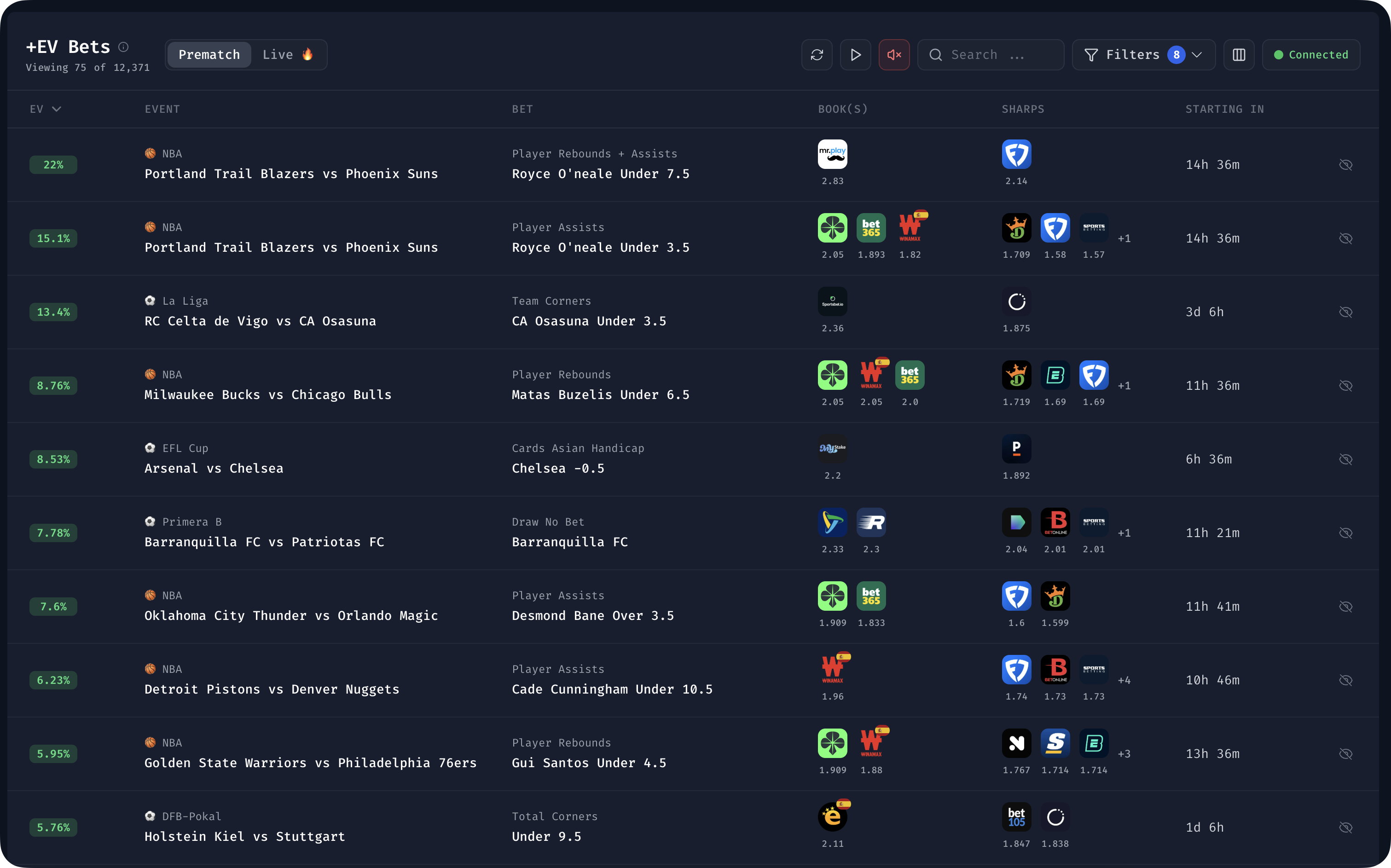
Our value bet scanner monitors for price discrepancies in real-time, alerting you when lines diverge from sharp consensus.
Betting Percentages vs. Money Percentages
Some sites report:
- Bet percentage: What portion of bets are on each side
- Money percentage: What portion of dollars are on each side
Key insight: Sharps bet larger amounts. When bet % and money % diverge significantly, sharps may be involved.
Example:
- Bet %: 70% on Chiefs
- Money %: 45% on Chiefs
Most bets are on Chiefs, but most money is on the opponent. This suggests larger (possibly sharp) bets on the opponent.
The Opening Line is the Truth
Sharp books (Pinnacle, Circa) set opening lines using sophisticated models. These opening lines represent the market's best pre-game estimate.
Sharp line theory:
- Opening line is "true"
- Movement from open is market information
- Closing line is most efficient
If you can bet a line before sharp money moves it, you capture value.
This is why betting early matters. Our article on closing line value explains this in detail.
Where Sharps Bet
Market Preferences
Sharps focus on:
- Sides (spread): Most liquid, highest limits
- Totals: Liquid, but less sharp attention
- Moneylines: Efficient but some value on underdogs
- First 5 innings/first half: Lower limits but sometimes soft
Sharps generally avoid:
- Parlays: Compound vig, no edge
- Props: Lower limits, harder to get down significant money
- Futures: Money tied up, high vig
Exception: Some sharps specialize in props or live betting where they've found systematic edge.
Books Sharps Use
Sharps bet at books that accept their action:
- Pinnacle (market maker, won't limit)
- Circa (Nevada, sharp-friendly)
- Bookmaker
- CRIS
When these books move, pay attention. They're not moving on public money.
Using Sharp Action in Your Betting
1. Track Opening Lines
Note where sharp books open. Compare to where lines close.
Consistent pattern? The direction of movement over time shows where sharp money flows.
2. Look for RLM Before Betting
Before betting, check:
- Which side has the public?
- Which direction is the line moving?
If the line is moving against public money, consider the sharp side.
3. Identify Steam and Act Fast
Sharp moves happen fast. If you see a line moving rapidly:
- Bet the steam direction if other books haven't caught up
- This is where Bet Hero's scanner helps: finding books that haven't adjusted yet
4. Compare to Pinnacle
Pinnacle's line is the market consensus. If a retail book deviates significantly:
- Either they have different information (unlikely)
- Or their line is soft
Betting against soft retail lines in the direction of Pinnacle is often +EV.
Limitations of Following Sharp Money
You're Getting a Worse Price
By the time you identify sharp action, the line has moved. You're getting the moved line, not the original.
If sharps bet Chiefs -3, you might be betting Chiefs -3.5. Some value is lost.
Sharp Action Isn't Always Right
Sharps are profitable long-term, not on every bet. A sharp bet at -3 might still lose.
Following sharp money improves your edge, it doesn't guarantee wins.
Over-Reliance is Dangerous
"Just follow sharps" isn't a complete strategy. You still need:
- Your own analysis
- Bankroll management
- Discipline
Sharp action is one input, not the whole picture.
Timing Matters
Sharp signals are time-sensitive. RLM that happened 4 hours ago might no longer be relevant. The value was captured.
Sharp Action by Sport
NFL
- Most attention from sharps
- Lines are tightest
- Sharp action early (Sunday night opens) has most value
- By kickoff, lines are very efficient
NBA
- High volume creates opportunity
- Rest/travel edges exist
- Early-season vs late-season profiling
- Totals sometimes softer than sides
MLB
- Pitching matchups create daily variation
- First 5 innings offers some sharps an edge
- Longer season = more data = more efficiency
Soccer
- Less sharp attention on non-premier leagues
- Live betting popular among some sharps
- Goal line markets can have soft numbers
Key Takeaways
- Sharp action is professional betting that moves lines
- Reverse line movement (line moves against public) signals sharp money
- Steam moves are rapid multi-book adjustments; act fast or miss value
- Bet % vs money % divergence suggests larger (possibly sharp) bets
- Opening lines are valuable; betting before sharp moves captures edge
- Use our value scanner to find lines that haven't adjusted to sharp consensus
- Pinnacle is the benchmark; deviations from Pinnacle suggest soft retail lines
- Following sharps isn't foolproof: you get worse prices and sharps aren't always right
- Sharp action is one input, not a complete strategy
- Timing matters: yesterday's sharp signal has no value today
Put this into practice
Bet Hero scans 400+ sportsbooks in real-time to find +EV bets and arbitrage opportunities so you don't have to.
Keep reading
Futures Betting Strategy: When to Bet and When to Hedge
Master futures betting with smart timing and hedging strategies. Learn when to bet season-long markets, how to manage positions, and when cashing out makes sense.
Prop Betting Strategy: Finding Edge on Player Props
Master player prop betting with proven strategies. Learn how to identify mispriced props, build projection models, and find consistent edge in the fastest-growing betting market.