
The Complete Guide to Arbitrage Betting in 2026
What Is Arbitrage Betting?
Arbitrage betting (also called sure betting or surebets) is a strategy that guarantees profit regardless of the outcome. By betting on all possible outcomes of an event across different sportsbooks, you lock in a profit when the combined odds create a mathematical opportunity.
How it works: Sportsbooks don't always agree on probabilities. When their disagreements are large enough, you can bet both sides and profit no matter who wins. You can spot these differences using an odds comparison tool.
Example:
Tennis match: Player A vs Player B
- Sportsbook 1: Player A at +110 (decimal 2.10)
- Sportsbook 2: Player B at +105 (decimal 2.05)
By betting the right amounts on each player at each book, you guarantee profit regardless of who wins.
This isn't gambling. It's exploiting price discrepancies across markets, similar to arbitrage in financial trading. The practice is built on the economic principle of the law of one price—identical goods should sell for the same price in efficient markets, and when they don't, profit opportunities exist.
How to Start Arbitrage Betting
Find and exploit guaranteed profit opportunities from pricing differences between sportsbooks.
- 1
Open multiple sportsbook accounts
Sign up with 10-20+ sportsbooks to maximize arbitrage opportunities. Include both sharp and soft bookmakers for the widest odds coverage.
- 2
Fund your accounts
Distribute your bankroll across your sportsbook accounts. Keep enough balance in each to place bets quickly when opportunities appear.
- 3
Use arbitrage scanning software
Subscribe to an arbitrage scanner that monitors odds in real-time across hundreds of bookmakers. Manual scanning is impractical as opportunities disappear within minutes.
- 4
Calculate your stakes
Use an arbitrage calculator to determine the correct stake for each leg. The calculator ensures your total payout exceeds your total stakes regardless of outcome.
- 5
Place both legs quickly
Speed is critical. Place both sides of the arbitrage as fast as possible to avoid odds movement. Start with the side most likely to change first.
- 6
Track your results
Log every arbitrage bet including the surebet percentage, stakes, and actual profit. Track by sportsbook to monitor which accounts are most active and at risk of limitation.
The Math Behind Arbitrage
Arbitrage opportunities exist when the sum of implied probabilities across all outcomes is less than 100%.
Calculating arbitrage percentage:
Arbitrage % = (1/Odds A + 1/Odds B) - 1
For the tennis example:
Arbitrage % = (1/2.10 + 1/2.05) - 1
Arbitrage % = (0.476 + 0.488) - 1
Arbitrage % = 0.964 - 1
Arbitrage % = -0.036 or -3.6%
A negative result means arbitrage exists. The magnitude (3.6%) is your guaranteed profit margin.
Why arbitrage opportunities exist:
- Different opinions: Books use different models and data
- Slow line movement: Some books adjust slower than others
- Regional differences: Books serving different markets price differently
- Promotional odds: Boosted odds create arbitrage with normal lines
- Market makers vs retail: Sharp books differ from recreational books
How to Calculate Arbitrage Stakes
Finding arbitrage is only half the equation. You must calculate the correct stake for each outcome.
Stake calculation formula:
Stake A = (Total Investment × Individual Implied Probability A) / Total Implied Probability
Or more simply:
Stake A = Total Investment / Odds A / (1/Odds A + 1/Odds B)
Full example:
You have $1,000 to invest in the tennis arbitrage:
- Player A: +110 (2.10) at Book 1
- Player B: +105 (2.05) at Book 2
Step 1: Calculate individual implied probabilities
- Player A: 1/2.10 = 0.476 (47.6%)
- Player B: 1/2.05 = 0.488 (48.8%)
- Total: 0.964 (96.4%)
Step 2: Calculate stakes
- Stake on A: $1,000 × (0.476/0.964) = $493.78
- Stake on B: $1,000 × (0.488/0.964) = $506.22
Step 3: Verify profits
- If A wins: $493.78 × 2.10 = $1,036.94 → Profit: $36.94
- If B wins: $506.22 × 2.05 = $1,037.75 → Profit: $37.75
Guaranteed profit: ~$37 (3.7% of $1,000), regardless of outcome.
Our arbitrage calculator does these calculations instantly.
Finding Arbitrage Opportunities
Arbitrage opportunities are rare and fleeting. You need systematic approaches to find them.
Manual searching (not recommended):
Comparing odds across dozens of books for thousands of markets daily is impractical. By the time you find an opportunity manually, it's usually gone.
Using arbitrage software:
Software scans odds across hundreds of sportsbooks simultaneously, calculating arbitrage percentages in real-time and alerting you to opportunities.
Key features to look for:
- Speed: Opportunities last seconds to minutes
- Coverage: More books = more opportunities
- Accuracy: Stale or wrong odds waste your time
- Filtering: By sport, arb%, minimum stake
- Direct links: Quick access to place bets
Our arbitrage finder scans 400+ sportsbooks in real-time, identifying sure bet opportunities and calculating optimal stakes automatically.
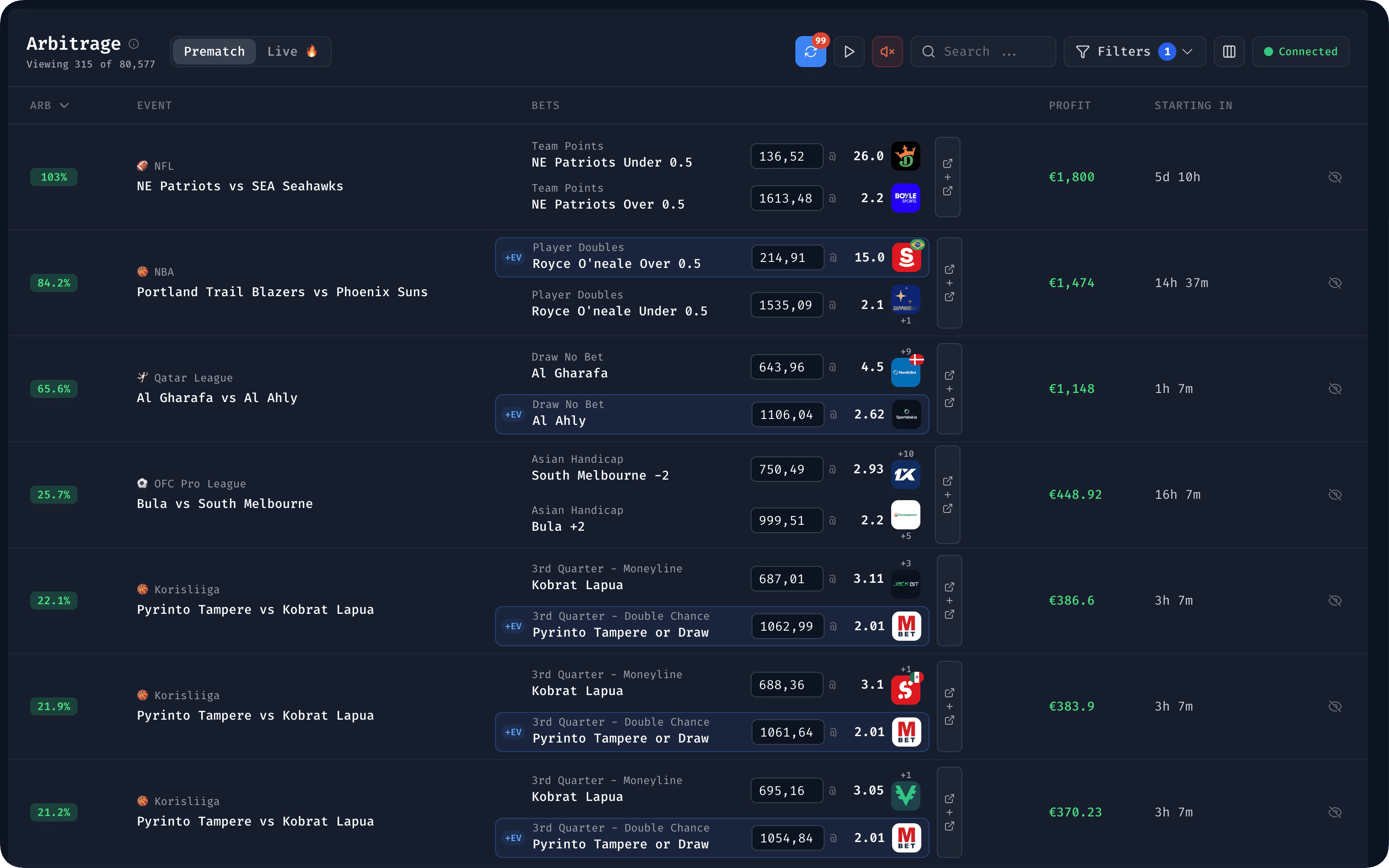
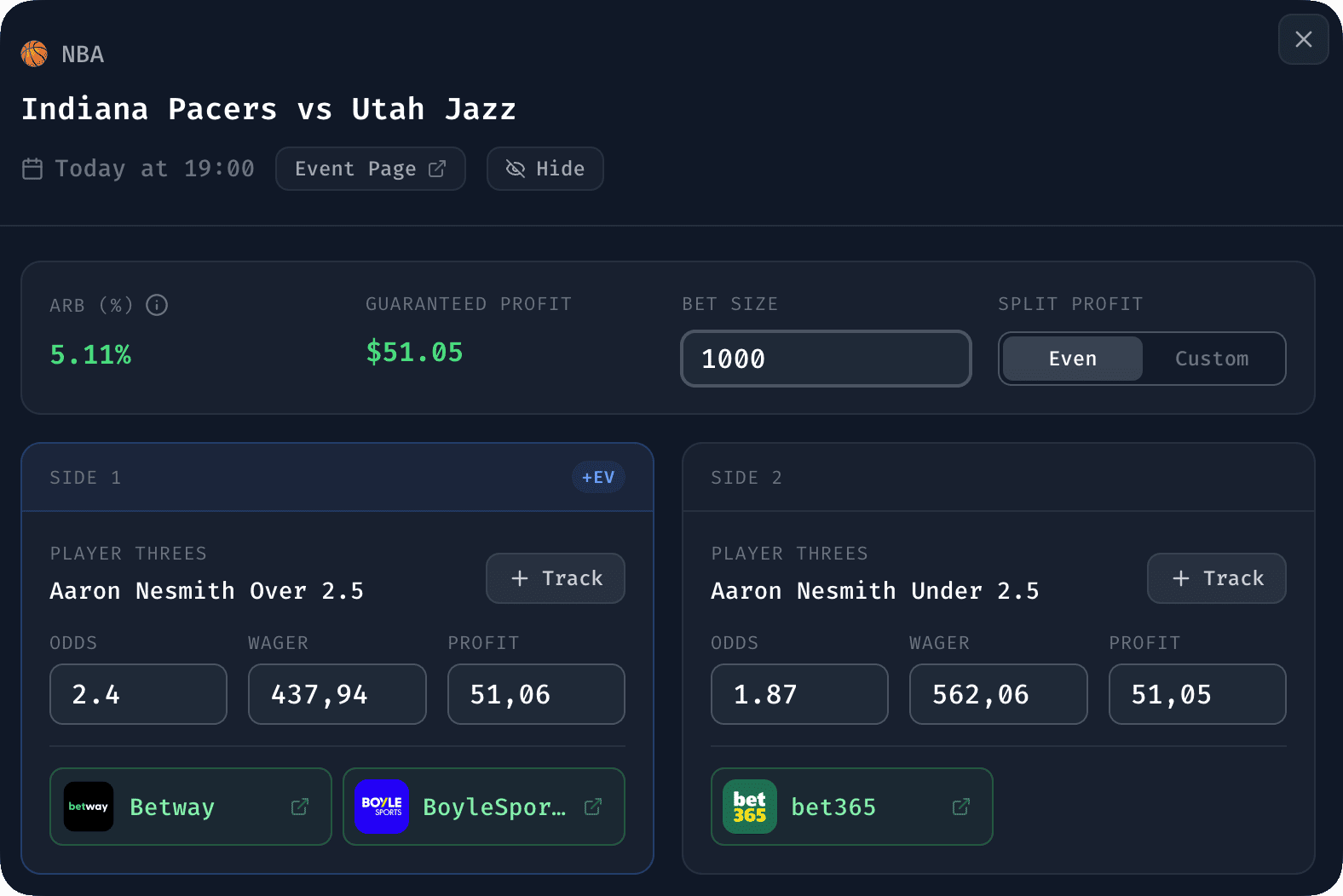
When arbitrage appears:
Most arbs emerge from:
- Line movements (one book adjusts, another lags)
- Promotional odds boosts
- Opening lines (before market stabilizes)
- Less popular markets (lower liquidity = more inefficiency)
Step-by-Step: How to Arbitrage Bet
Step 1: Set up your infrastructure
- Open accounts at 10-20+ sportsbooks
- Fund each with capital (distribute based on book quality)
- Verify all accounts to enable withdrawals
- Save login credentials securely
Step 2: Find arbitrage software
Choose reliable software with:
- Good book coverage in your region
- Fast odds updates
- Positive user reviews
- Reasonable pricing
Step 3: Configure your settings
- Set minimum arbitrage percentage (1-2%+ recommended)
- Select your funded sportsbooks
- Choose sports and markets to scan
- Set maximum stakes based on your bankroll per book
Step 4: Monitor and act fast
When an arb appears:
- Click to open both sportsbook links
- Verify odds are still available
- Calculate stakes (software usually does this)
- Place the first bet (usually the less liquid side)
- Immediately place the second bet
- Confirm both bets went through
Step 5: Manage outcomes
- Track all arbs in a spreadsheet or tracker
- Monitor for voided bets or odds changes
- Rebalance funds across books as needed
- Calculate actual vs expected profit
Critical timing:
The window for most arbs is 30 seconds to 5 minutes. Speed is everything. If you can't place both bets quickly, don't start the first one.
Risks and How to Manage Them
Arbitrage isn't truly "risk-free." Several risks exist.
1. Palping (one leg failing)
You place the first bet, but before placing the second, the odds change or the bet is rejected. You're now exposed on one side.
Mitigation:
- Place the less liquid bet first
- Only arb on markets with stable odds
- Have backup books ready
- Don't arb with your full bankroll on the line
2. Bet voiding
A sportsbook voids your bet due to an "obvious error" in odds. If one side voids and the other doesn't, you're stuck.
Mitigation:
- Avoid arbs that look like mistakes (extremely high odds)
- Screenshot your bet confirmations
- Understand each book's terms on palpable errors
3. Account limiting
Sportsbooks hate arbers. Consistent arbitrage betting leads to severe limits quickly, often faster than value betting.
Mitigation:
- Use many accounts across many books
- Mix in some recreational bets
- Don't arb the exact same markets repeatedly
- Withdraw infrequently
- Follow the delay strategies from value betting
4. Funds locked across books
Your capital is spread across 15+ books. You might need $500 at Book A but have $50 there and $500 sitting idle at Book B.
Mitigation:
- Maintain minimum balances everywhere
- Rebalance regularly (but not too frequently)
- Start with higher bankroll per book
5. Currency and withdrawal issues
Different books operate in different currencies. Conversion fees and withdrawal minimums eat into profits.
Mitigation:
- Account for fees in your calculations
- Use books with your local currency
- Batch withdrawals to reduce fees
Arbitrage Betting Capital Requirements
Arbitrage requires significant capital because:
- Profits per bet are small (1-5%)
- Money is tied up across many accounts
- You need enough to bet both sides simultaneously
Minimum recommended capital:
- Beginner: $2,000-5,000 across 10 books
- Intermediate: $5,000-15,000 across 15-20 books
- Advanced: $15,000+ across 20+ books
Capital efficiency:
If you have $5,000 spread across 10 books ($500 each):
- Each arb might use $200-500 total stake
- Typical arb profit: 2-3% = $4-15 per arb
- Daily volume: 5-20 arbs
- Daily profit: $20-200
Monthly projection (intermediate):
- $10,000 capital
- Average 10 arbs/day at 2.5% each
- Average stake: $400
- Daily profit: $100
- Monthly profit: ~$2,000-3,000 (before limiting impacts)
Account Management for Arbers
Opening accounts strategically:
- Start with major books in your region
- Add secondary books over time
- Verify identity promptly
- Take advantage of signup bonuses (additional profit)
Funding strategy:
Don't fund all accounts equally. Prioritize:
- Books with softer odds (more arb opportunities)
- Books with higher limits
- Books that limit slower
Rebalancing:
After arbs, winning sides accumulate funds while losing sides deplete. Periodically rebalance by:
- Withdrawing from heavy accounts
- Depositing into light accounts
- Timing withdrawals to look recreational
Tracking balances:
Maintain a spreadsheet with:
- Current balance at each book
- Pending bets
- Recent deposits/withdrawals
- P&L per book
Sports and Markets for Arbitrage
Best sports for arbitrage:
- Tennis: Most arbitrage opportunities, fast-moving lines
- Soccer: High liquidity, many markets, global book diversity
- Basketball (NBA/NCAAB): Good liquidity, frequent line movement
- Baseball (MLB): Moneyline-heavy, creates arb opportunities
- Hockey (NHL): Less attention, occasional soft lines
Best market types:
- Moneylines: Simplest, most common arbs
- Totals: Over/under creates 2-way arbs
- Spreads: Point spreads across books diverge
- Set/game betting: Tennis and volleyball sets
Markets to approach carefully:
- Player props: Lower limits, higher void risk
- Live betting: Odds change too fast for most
- Futures: Money tied up long-term
- Parlays: Never suitable for arbing
Two-Way vs Three-Way Arbitrage
Two-way arbitrage:
Most common. Two possible outcomes (e.g., tennis match, over/under, spread).
Calculation: 1/Odds A + 1/Odds B < 1
Three-way arbitrage:
Three possible outcomes (e.g., soccer match: home/draw/away).
Calculation: 1/Odds A + 1/Odds B + 1/Odds C < 1
Example three-way:
Soccer match with no draw option removed:
- Home: 2.50 at Book 1 (40% implied)
- Draw: 3.50 at Book 2 (28.6% implied)
- Away: 3.20 at Book 3 (31.25% implied)
- Total: 99.85%
This is barely an arb (0.15%), likely not worth the effort.
Three-way arbs are rarer and require more capital spread across three books simultaneously.
Live Arbitrage Betting
Live (in-play) arbitrage is theoretically possible but extremely difficult.
Challenges:
- Odds change every few seconds
- Bet placement has delays
- Higher risk of one leg failing
- Many books limit live bet sizes
- Requires split-second execution
When live arbs work:
- During natural breaks (timeouts, halftime)
- When one book is slow to update
- On niche sports with less automated pricing
Tools for live arbs:
Specialized software with:
- Sub-second odds updates
- One-click betting integration
- Automatic stake calculation
For most bettors, prematch arbitrage is more practical and less stressful.
Arbitrage vs Value Betting: Comparison
| Factor | Arbitrage | Value Betting |
|---|---|---|
| Risk | Very low (guaranteed profit) | Medium (variance) |
| ROI per bet | 1-5% | 2-10%+ |
| Monthly ROI | 10-30% of active capital | 5-20% of bankroll |
| Capital needed | High | Medium |
| Limiting speed | Fast (weeks-months) | Moderate (months-year) |
| Time required | High (monitoring, speed) | Medium |
| Emotional stress | Low | Higher (variance) |
Which to choose?
- Choose arbitrage if: You have significant capital, want guaranteed returns, can handle fast execution, and are okay with rapid limiting.
- Choose value betting if: You want higher long-term returns, can handle variance, have less capital, and want accounts to last longer.
- Choose both if: You want diversified approaches and have enough capital for both strategies.
Calculating Your True ROI
Arbitrage ROI isn't just profits divided by total capital. Your capital isn't fully deployed at all times.
Active capital ROI:
Track the capital actively at risk in arbs, not total capital across all books.
Example:
- Total capital: $10,000 across books
- Capital actively arbed daily: ~$2,000 average
- Monthly profit: $600
- ROI on active capital: 30%
- ROI on total capital: 6%
Time-adjusted returns:
Factor in hours spent:
- 2 hours/day finding and placing arbs
- $600/month profit
- 60 hours/month
- Hourly rate: $10/hour
Is that worth it? Depends on your alternatives and goals.
Common Arbitrage Mistakes
1. Betting too slowly
Opening the first bet, then slowly navigating to the second book. By then, odds changed. Either bet both within 30 seconds or don't start.
2. Ignoring currency conversion
Arbing between books in different currencies without accounting for conversion fees. A 2% arb becomes 1% or negative after fees.
3. Arbing palpable errors
That +500 underdog that should be -200? The book will void it. Obvious errors get caught and voided.
4. Neglecting bankroll distribution
Putting 80% of your money in one book because it has the best odds. When you can't place the second leg elsewhere, you're stuck.
5. Over-arbing the same markets
Repeatedly arbing NFL spreads at the same two books trains them to limit you faster. Diversify.
6. Forgetting about bonuses
Many books require wagering before withdrawal. Arbing with bonus funds might violate terms and forfeit your balance.
7. Poor record-keeping
Without tracking, you don't know your actual profit, which books are limiting, or where your money is.
Getting Limited: The Inevitable End
Sportsbooks will limit you. It's not if, but when.
Signs you're being limited:
- Maximum bet amounts decreasing
- "Bet cannot be placed" errors
- Odds changing only for you
- Withdrawal scrutiny increasing
Average timeline to limiting:
- Aggressive arbing: 2-4 weeks per book
- Moderate arbing with camouflage: 1-3 months per book
- Careful with recreational mix: 3-6 months per book
What to do when limited:
- Move to other accounts you've preserved
- Open new books as they launch in your region
- Consider sharp-friendly books (accept arbing)
- Pivot more toward value betting
- Use betting exchanges (harder to limit)
Sharp-friendly books:
Some books welcome sharp action:
- Pinnacle
- Circa (Nevada)
- Bookmaker
- Betting exchanges (Betfair, Betdaq)
These have lower margins, so arbs involving them are smaller, but your accounts last indefinitely.
Tools for Arbitrage Betting
Essential:
- Arbitrage scanner - Finds opportunities in real-time
- Multiple funded accounts - 10-20+ sportsbooks
- Arbitrage calculator - Calculates optimal stakes
- Spreadsheet/tracker - Records all bets and balances
Helpful:
- Browser with multiple profiles - Stay logged into all books
- Fast internet connection - Speed is critical
- Odds converter - American/decimal/fractional conversions
- Screen with split view - See both books simultaneously
- Betting directories - Find more tools and sportsbooks in one place (e.g., Alllister, SportsLink)
Our tools:
- Arbitrage Finder - Real-time surebets across 400+ books
- Arbitrage Calculator - Calculate stakes for any arb
- Bet Tracker - Track all your arb bets and profits
- Value Bet Scanner - Diversify with +EV single bets
Key Takeaways
- Arbitrage betting guarantees profit by betting all outcomes across different books
- Opportunities exist when combined implied probabilities are under 100%
- Calculate stakes precisely to lock in profit regardless of outcome
- Speed is critical - opportunities last seconds to minutes
- Use software to scan hundreds of books simultaneously
- Manage risks: palping, voiding, limiting, capital distribution
- Expect limiting - accounts last weeks to months with arbing
- Capital requirements: $2,000-5,000 minimum, $10,000+ recommended
- ROI expectations: 10-30% monthly on active capital (initially)
- Combine strategies: Arbitrage for consistency, value betting for growth
Arbitrage betting is one of the closest things to guaranteed money in sports betting, but it requires capital, speed, and acceptance that you'll eventually get limited. Use it while you can, and diversify into value betting for longer-term sustainability. For a detailed comparison, see value betting vs arbitrage betting.
Ready to find arbitrage opportunities? Our surebet scanner identifies guaranteed profit opportunities in real-time across 400+ sportsbooks. Start locking in profits today.
Frequently Asked Questions
What is arbitrage betting?
Is arbitrage betting legal?
How much starting capital do you need for arbitrage betting?
Is arbitrage betting risk-free?
How do I find arbitrage opportunities?
Can sportsbooks detect arbitrage betting?
How many sportsbook accounts do I need?
How fast do arbitrage opportunities disappear?
Related Calculators

Juan Sebastian Brito is the CEO and Co-Founder of Bet Hero, a sports betting analytics platform used by thousands of bettors to find +EV opportunities and arbitrage. With a background in software engineering and computer science from FIB (Universitat Politècnica de Catalunya), he built Bet Hero to bring data-driven, mathematically-proven betting strategies to the mainstream. His work focuses on probability theory, real-time odds analysis, and building tools that give bettors a quantifiable edge.
View all articles →Put this into practice
Bet Hero scans 400+ sportsbooks in real-time to find +EV bets and arbitrage opportunities so you don't have to.
Keep reading
Arbitrage Betting Explained: Lock In Guaranteed Profits
Learn how arbitrage betting guarantees profit by exploiting odds differences. Includes surebet examples, stake calculations, and risk management tips.
The Complete Guide to Value Betting in 2026
Complete value betting guide covering +EV detection, stake sizing, variance, and handling limits. Includes edge sizing examples and sanity checks.